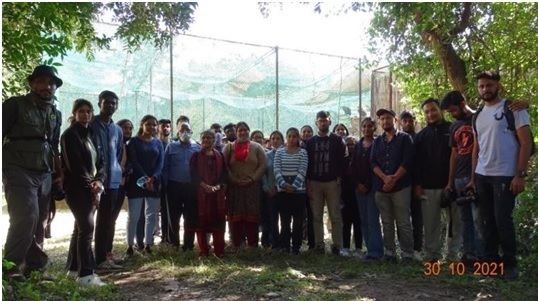
On October 30, 2021 the students of M.Sc. Forestry (3rd semester) went on educational cum practical tour to Pinjore, Haryana. The primary interest was to visit Jatayu Conservation Breeding Center (JCBC), Soil and Water conservation practices and Herbal garden established and maintained by the Haryana Forest Department under the guidance of Mrs. Natalya Krishnambika.
Jatayu Conservation Breeding Center which is a collaborative initiative between Bombay Natural History Society (BHNS) and the Haryana Forest Department lies at the edge of Bir Shikargah Wildlife Sanctuary in Morni Hills of Shivalik ranges of the Himalayan foothills. The center was established in September 2001 to look into the dramatic declines in India’s Gyps species of vultures and save the three species of vultures, the Oriental white-backed, Long billed and Slender-billed, from the emerging extinction caused by a drug diclofenac which is given to livestock as anti-inflammatory drug. The breeding center has various types of aviaries for keeping the vultures of different age classes namely Nursery Aviaries, Colony Aviaries, Holding Aviaries, Hospital Aviaries, Display Aviaries, Quarantine Aviaries and Pre-Release Aviaries and also has well equipped laboratory. Students got the opportunity to learn about the artificial incubation of Gyps Vulture eggs.
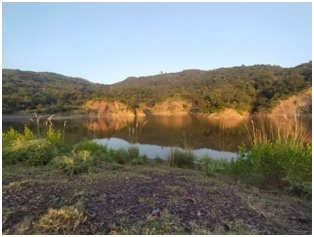
The soil and water conservation measures adopted by the Haryana Forest Department was also demonstrated, where the catchment area treatment and water harvesting structures were made by the structural interventions coupled with biological remedial structures. A dam was constructed for collecting the natural precipitation and to channel water for irrigation and water supply. The third destination was visit to Karpoor Vatika (Herbal Garden) established in 2005 by Haryana Forest Department. The Herbal garden has been developed on an area of 10 ha with 114 species of medicinal plants. Students got the chance to identify the species with their medicinal uses. Some of the plant species spotted in the herbal garden were Taxodium mucronatum, Iberis amara, Centella asiatica, Coleus barbatus, Asparagus adscendens, Terminalia chebula, Elettaria cardamomum, Plumbago indica, Tylophora indica, Narcissus tazetta, Rauwolfia serpentina, Sterculia urens, Santalum album.
The scholarly efforts and attitude got completed successfully and the trip helped the students to have the practical knowledge about soil and water conservation practices, species in herbal garden with their uses and the cause of decline in the vulture population and their importance and need for the conservation as they are nature’s efficient scavengers, prevents outbreak and spread of infectious disease such as anthrax, rabies and occupy a key ecological niche that helps in sustaining a natural and healthy environment.
Amit Yadav
Student (M.Sc. Forestry, 3rd Sem)